Advanced Separation Engineering for Clean Energy Systems and Critical Resource Recovery
Mission: Advancing sustainable energy and critical resource recovery through innovative separation and purification technologies
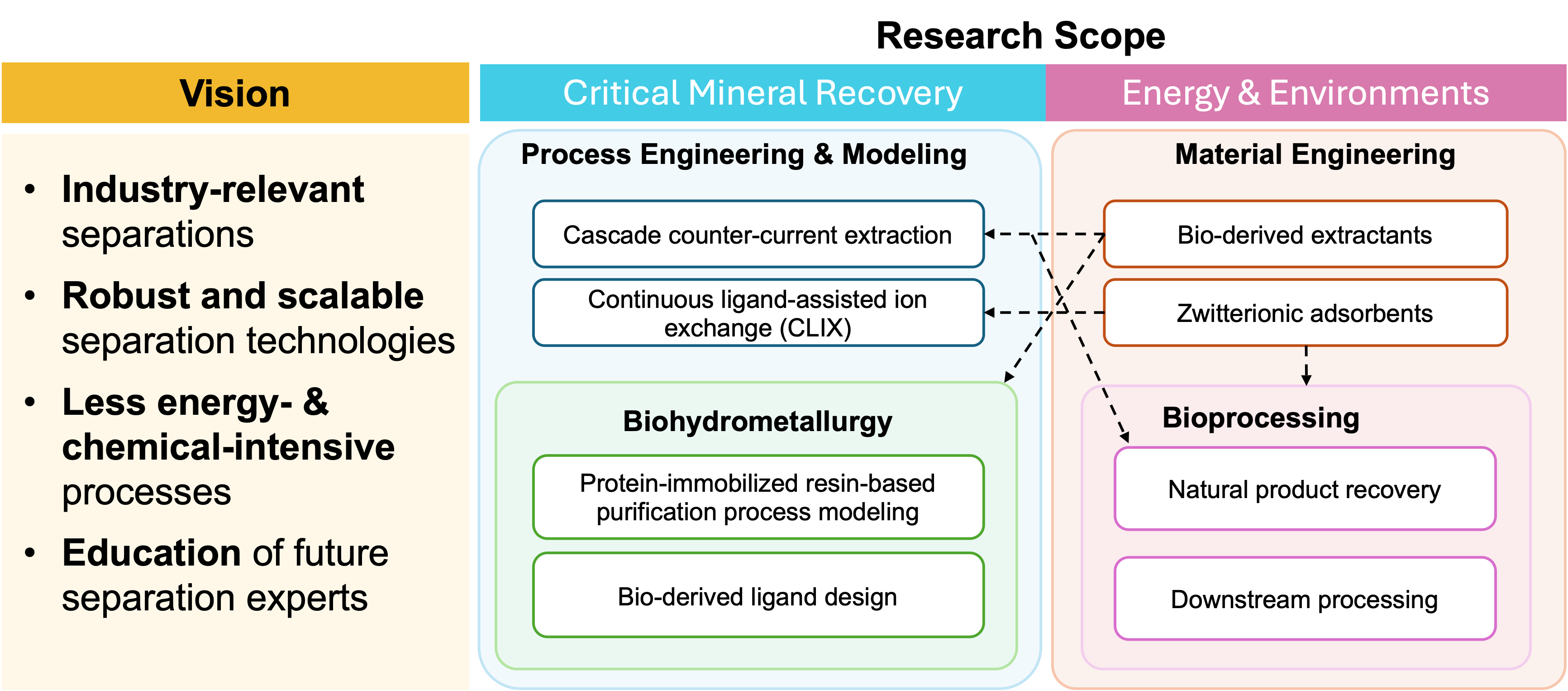
Figure Overview: Research Scope and Framework of the ASeP Lab Our research framework tightly integrates multi-scale process modeling and hands-on experimentation to drive fundamental and applied innovations across three core directions: (1) Target Separation Processes & Vision (industry-relevant, robust, and scalable continuous separation technologies with minimized energy and chemical intensity), (2) Critical Mineral Recovery (advanced process engineering, cascade counter-current extraction, and continuous ligand-assisted ion exchange [CLIX]), and (3) Renewable Biomass Valorization (bio-derived extractants, zwitterionic adsorbents for downstream bioprocessing, and natural product purification).
Our research focuses on designing innovative separation processes through modeling and experimentation.
We utilize a comprehensive approach, striving to advance separation processes for recovering critical minerals and leveraging renewable resources.
Research Interests
- Separation and Purification
- Adsorption / Chromatography / Extraction
- Critical Mineral Recovery
- Natural Product Separations
- Chiral Separations
- Downstream Biorocessing
Open Source Software
-
ASeP LC Simulator: A GUI tool for simulating various modes of liquid chromatography. Please email Dr. Choi if you have any questions.
-
CUP Modeler: A free Python-based GUI tool for simulating various modes of liquid-liquid chromatography (counter-current chromatography and centrifugal partitioning chromatography) processes. Please email Dr. Choi if you have any questions.
- Citation: Alherech M., Beckham G.T., & Choi H. (2025). Implementation and Evaluation of Multi-Dual Mode Counter-Current Chromatography in the CUP Modeler Software. Journal of Chromatography A, 1760, 466265.
Current Research Projects
- Continuous Liquid-Liquid Chromatography Modeling and Simulations
- We are developing novel continuous liquid-liquid chromatography platforms optimized for critical resource recovery and challenging chemical separations.
- Ligand Screening for Critical Mineral Separations
- We focus on high-selectivity ligand screening to enable efficient separation of critical minerals and apply these findings into chromatography separation platforms.